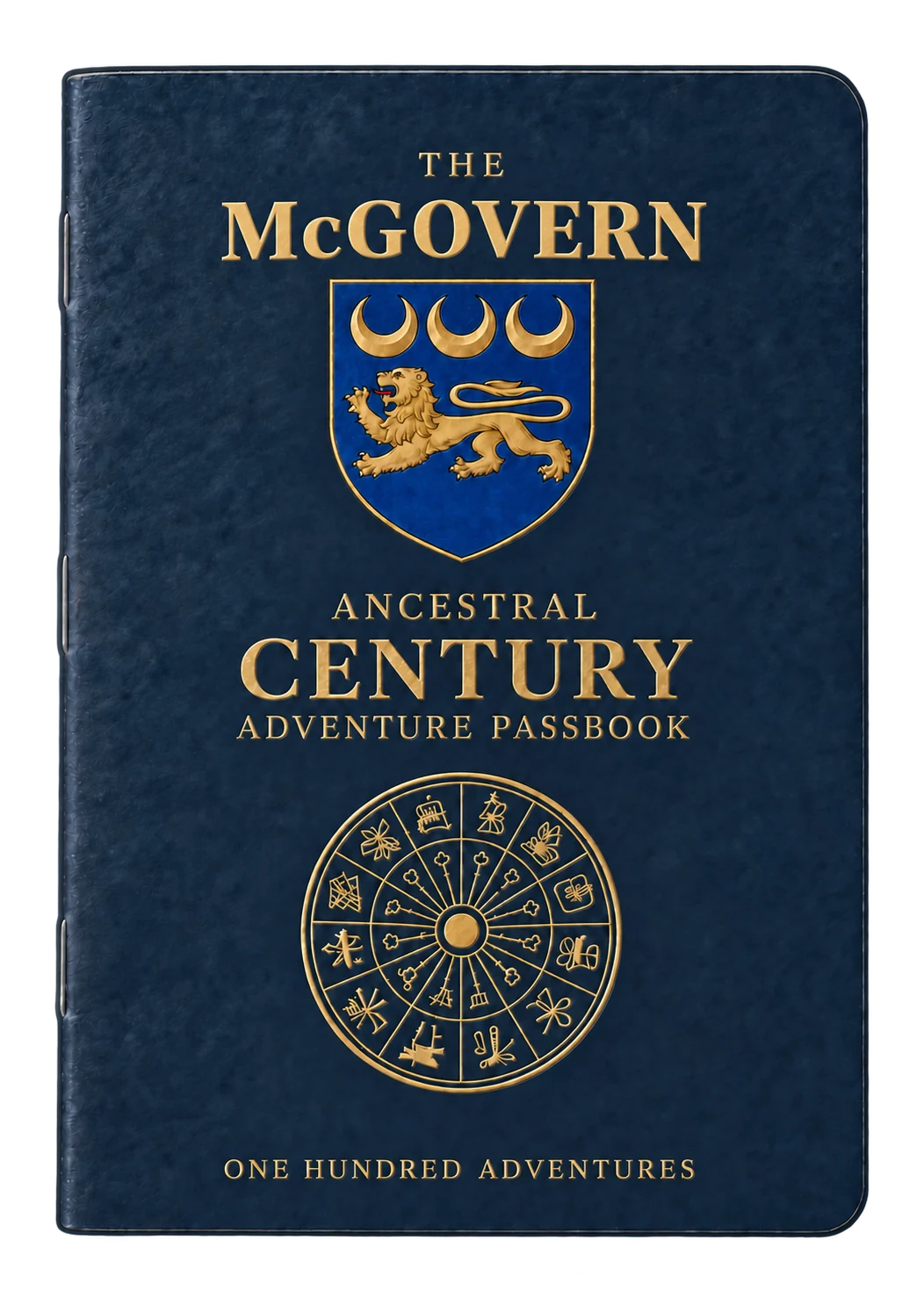
The Century System
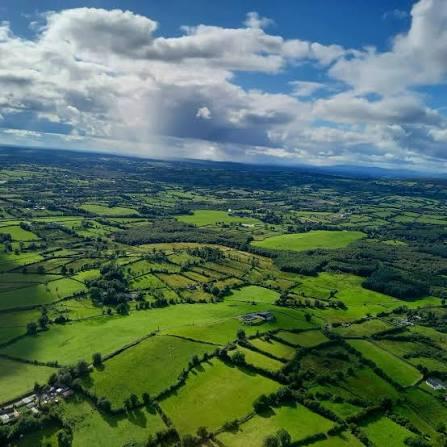
Tullyhaw and Ballymagauran
The core family territory and the seat of the lordship.
- Cross Tullyhaw
- Ballymagauran
- Castle Magauran
- Coologe
- Maherloob

Explore a sample Wheel from the McGovern Ancestral Century.
The Ancestral Century takes you on a journey through time and place, through a series of adventures structured around the family’s history. Genealogy has long provided details, but the spine of this journey is written in blood — the DNA markers.
It carries the history of the McGovern clan from the 1800s back some two thousand years.
The Hundred begins with the McGovern name — in Irish, Mág Shamhradháin — and the family territory of Tullyhaw. It follows the record through manuscripts, parish books, townlands, graveyards, churches, lakes, food, family stories, and modern DNA research.
Record your journey in the digital Passbook. Complete the categories and the Hundred to earn your final seal and Centurion recognition. Printed Passbooks and family coins are optional keepsakes.
No. 99 is set by the King. No. 100 is the Centurion’s Choice: the player repeats the adventure that meant the most.
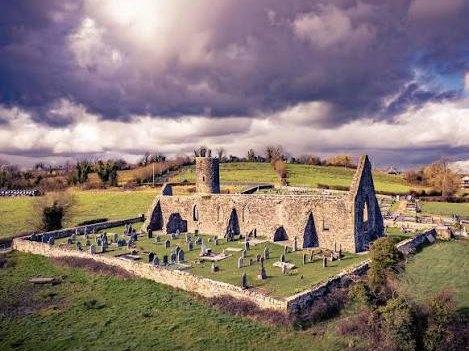
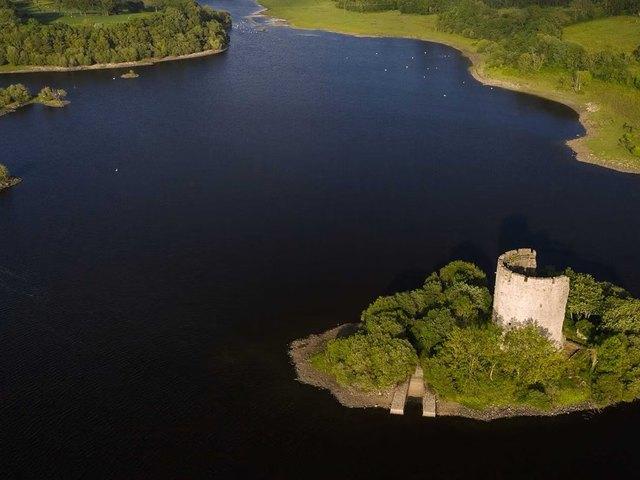
The complete Hundred remains in the Passbook and the Century Companion.
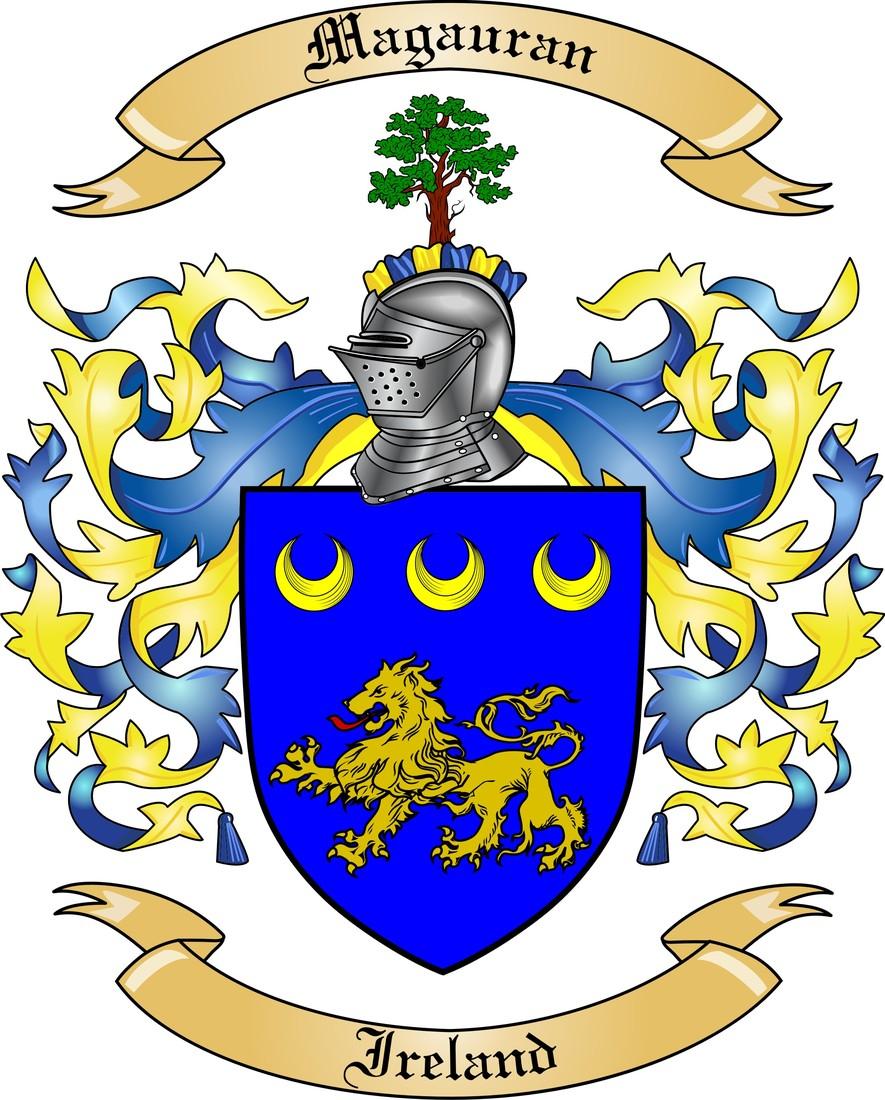
A blue shield with a gold lion walking and three gold crescents across the top. These are the arms most often shown for the name, under both the Magauran and McGovern spellings. They appear in the printed lists of Irish family arms. No record found so far names the man they were first granted to, or the year. The oak tree above the helmet is the crest John O’Hart gives for the Magauran family.
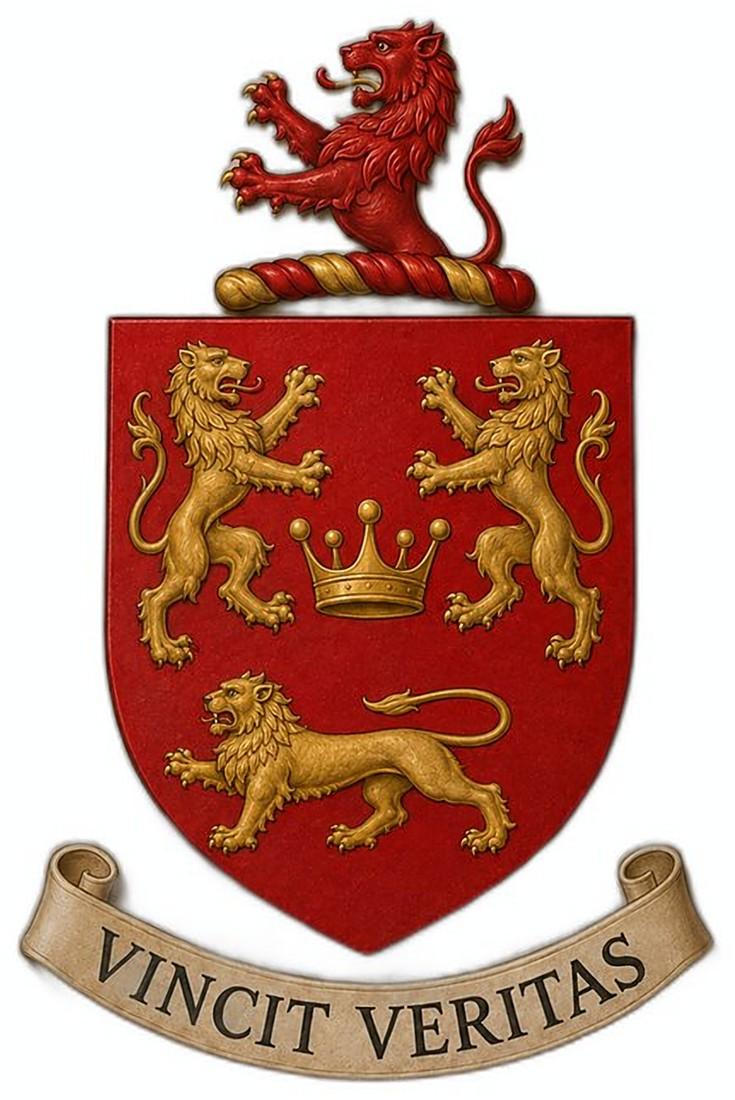
John O’Hart gives a second set of arms under the name MaGauran, in the Addenda to Irish Pedigrees: Or, The Origin and Stem of the Irish Nation (fifth edition, 1892). He describes a red shield with two lions and a third lion walking, with a crown in the center. The crest is a red half-lion standing. The motto is Vincit Veritas, Truth Conquers. The same entry names the MaGaurans as lords of Tullyhaw. O’Hart printed only the words. The painting shown here was made from his description.
O’Hart’s main Magauran pedigree gives a third coat of arms. It is a silver shield with an oak tree on a green mound. Across the top is a blue band with a silver crescent between two silver stars. The crest is an oak tree. No picture of it is shown here.
O’Hart’s Magauran pedigree · O’Hart’s MaGauran Addenda entry
In Irish the name is Mág Shamhradháin. At its center is a sound English has no letter for, the one an English speaker knows from the Scottish loch. The clerks who wrote Irish names into English records reached for gh, a letter that had once carried that sound in their own language and by then no longer did, and every reader afterward pronounced the letters rather than the sound they stood in for.
That single difficulty produced every spelling of the name still in use. Mág Shamhradháin came out as Magauran in one clerk’s hand, McGovern in another, and Magowran, McGauran, and McGowran in others. Every one of them is the same name. The variants were never different families going their separate ways. They are one name passing through an alphabet that could not hold it, the same way Teallach Eachdhach, the household of Eochaidh, became Tullyhaw in the same clerks’ hands.
The families themselves went on saying the Irish for as long as the language held, and their neighbors went on hearing it. What changed, generation to generation, was only which Englishman was holding the pen.
What DNA adds to a thousand years of records. Explore the names, places, medieval poems, and living family connections behind the McGovern and Magauran story.
The family narrative combines four forms of evidence: recorded history, medieval tradition, place-based archaeology, and modern Y-DNA research. Where an adventure already reaches a moment in the story, its number is given alongside it.
The Ancestral Century begins with DNA. A line is read, its markers dated and placed, and what comes back is a movement across ground — where a family was living, and when, long before any document names it. Traditional genealogy then works the other way, from the present backward through parish books, manifests, stones and town records, until the paper thins.
Where the records survive, the story below is told through history, tradition and adventure; where they end, the DNA carries the line past them. Adventures 1 through 8 run on tradition and archaeology — Tara, Magh Slécht, the entry into Tullyhaw — because no document reaches that far back. From the Book of Magauran forward, the paper record carries the story. The DNA sequence, R-M222 through FT76652, runs underneath all of it, the one thread that was there before the paper and will still be there after it runs out.
We begin our journey in Ireland almost two thousand years ago, between the second and fifth centuries. In that time a single change occurred in the Y chromosome of one man. It has been passed from father to son, unbroken, to the present day. That marker is R-M222. It is common among men whose families come from northwest Ireland and the Gaelic parts of Scotland. It places its carriers among the Connachta, the descendants of Conn of the Hundred Battles. The old genealogies place this family in the same world.
The genealogical tradition places the family within the world of Conn of the Hundred Battles, Eochaid Muigmedón, and Bríón — the same figures whose names anchor the wider Connachta story. A visitor can still stand on the hill where that world is remembered.
Magh Slécht was a major ritual landscape in what became County Cavan, long before any family held it by name. Medieval accounts tie it to Crom Cruach, to Samhain, to kingship and harvest. The Killycluggin Stone, and the circle of stones around it, are physical evidence that the ground held unusual importance well before the written record begins.
The ancestors of the family entered the high wilderness around the Cuilcagh Mountains around the middle of the ninth century — a small people settling ground the established lords to the south had not yet reached. Over the centuries that followed they pressed south, and by the thirteenth century held the whole of Tullyhaw. Teallach Eachdhach, the household of Eochaidh, is what the Irish name means; said aloud by generations of English clerks, it became Tullyhaw.
Samhradhán was chief of Tullyhaw from about 1082 to 1115. His son Muireadhach, chief from about 1115, was the first to be called Mág Samhradháin, son of Samhradhán. The family name begins with him. Over the following centuries English clerks wrote it as Magauran, McGovern, McGauran, McGowran and more. Every one of them is the same name.
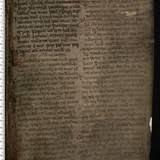
By the thirteenth century the chiefs of Tullyhaw appear repeatedly in the Irish annals, ruling from a seat at Ballymagauran, beside the lake that gave the place its water and its name. The family patronized poets, fought and allied with the O’Rourkes, the O’Reillys, and the Maguires, and became deeply associated with Drumlane, Templeport, Ardagh, and Kilmore. Their own book survives from this world: the Book of Magauran, National Library of Ireland MS G 1200, thirty-three bardic poems preserved in whole or in part, assembled for the ruling family and among the oldest surviving Irish family poem books. A page from it can still be read.
Members of the family held church office across several generations at Drumlane, Templeport, Ardagh, and Kilmore. The most prominent, Archbishop Edmund, became a leading Catholic organizer, traveled widely across Europe, and in 1593 died in battle near Tulsk, at the place Irish sources call Sciath na Feart and the maps call Skeanavart, fighting alongside Hugh Maguire. His own side described him, at the end, arbitrating a quarrel between kinsmen over stolen cattle — a churchman doing a churchman’s work in the middle of a war.
The family was among the last of the Gaelic lords to submit to English rule. Its home ground is named outright in the 1609 Cavan Inquisition, taken on the eve of the Plantation itself — the townland of Ballymagauran set down by name in a Crown survey of what was about to be taken. In 1641 a member of the family led McGovern forces into rebellion; an English officer garrisoned at Cloughoughter recorded the rebels of the barony by name the following spring. The resistance ran on, in the same company and on the same ground, for the rest of the century.
The people chose Peter Magauran as King in 1815, and his sister Elizabeth was named Queen beside him. They were of Moneensauran, the same townland where Samhradhán himself had lived seven centuries before. The family stood high in Cavan, and many of its men became priests. Their brother, the Right Reverend James Magauran, was elected Bishop of Ardagh and Clonmacnoise that same year. Their judgments were never appealed to any outside authority.
Cavan’s land, like the rest of Ireland’s, was reshaped by the Famine years. What followed was a common pattern across the county: a small holding passed whole to a single heir rather than being divided past the point of use, and the rest of a family was provided for by marriage, by the Church, or by emigration. One stayed and held the ground; the others were sent to make their own way.
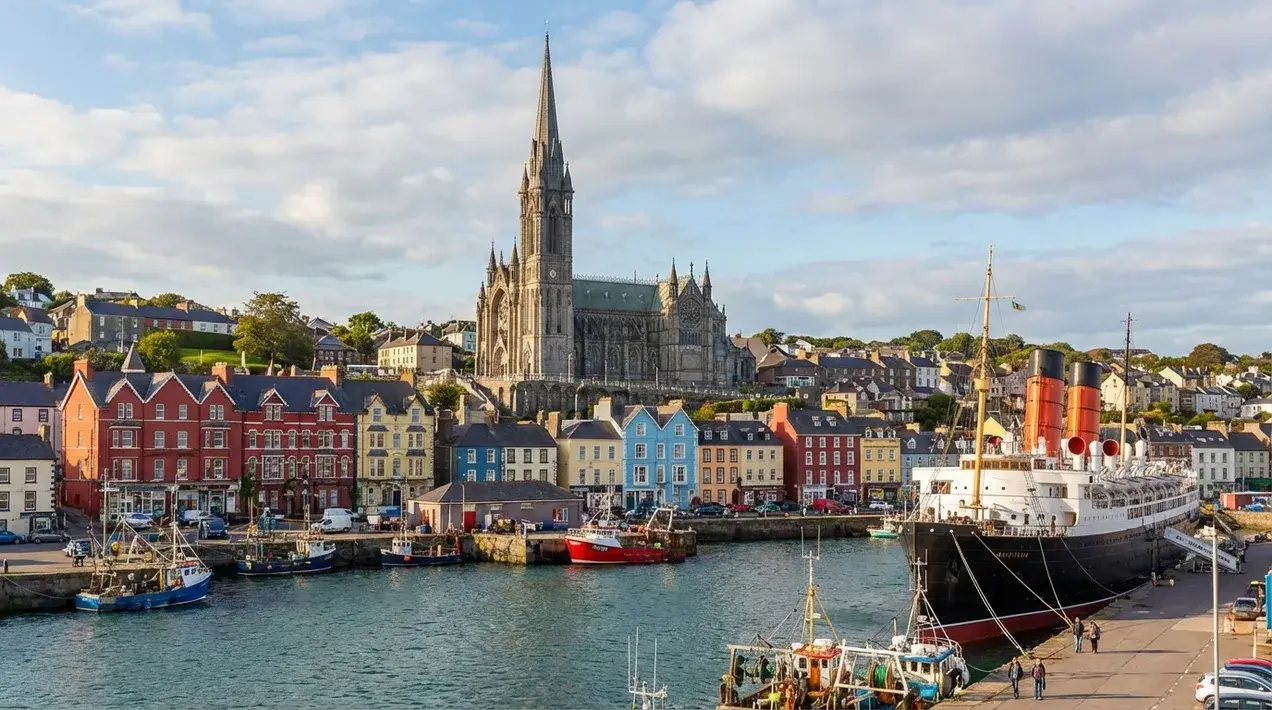
Parish records, graves, and emigration records carry the family’s story into the modern era. Generation after generation left from the same Irish port — Cobh, once called Queenstown — for a new country.
R-M222 to A259 to A260 to A5902 to FGC59200 to BY18134 to FT76652: seven markers, each one a single change that happened once, in one man, and was carried forward unaltered ever since. The chain is not finished. A thousand years of mutation lies between the last confirmed step and the men living now, waiting on cousins not yet tested. The record runs from a hillside at Tara to a farm at Moneensauran to a harbor at Cobh — and it is still being written.
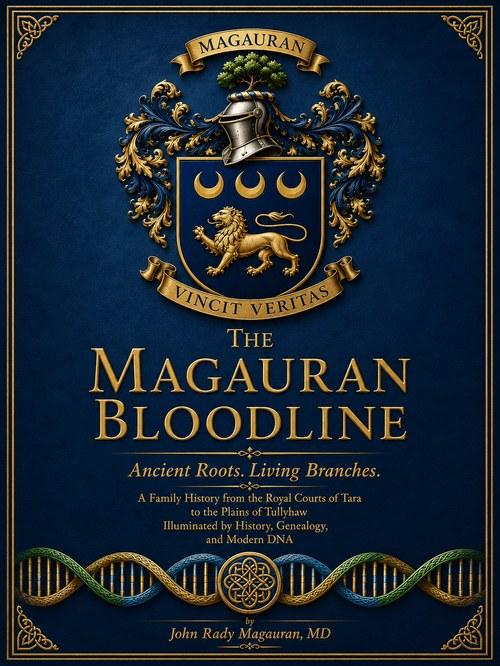
The Book of Magauran, the family’s own medieval manuscript, is held at the National Library of Ireland as MS G 1200 and can be consulted there. The Magauran Bloodline is the full family history developed from that record and the wider family archive.
$76 per copy, plus applicable sales tax, shipping, and handling.
The King’s Desk will confirm availability, the final total, and payment instructions before processing your order.
The Hundred is organized by places a traveler can understand and use. Each place connects a family fact to an adventure.
The core family territory and the seat of the lordship.
The ritual and religious landscape at the center of the early story.
Water links the townlands, the archaeology, and the daily life of Cavan.
Church, learning, and the family’s long ecclesiastical record.
The civic center, the later family record, and the famine landscape.
The neighboring territory tied to Maguire alliances and the northern story.
The ecclesiastical center connected to Archbishop Edmund McGovern.
The manuscript, the annals, and the national collections.
The Connachta, the wider historical route, and the point of emigration.
Explore the sample Wheel. An issued Passbook number opens the full Century and your digital record, with adventures filtered by location, difficulty, and category. No printed book is required.
The King’s Desk will confirm availability, price, tax, shipping, handling, and payment instructions.