
The Grapevine · Special Interest · Culinary Heritage
At the royal table
The Medieval Aristocratic Table
The spectacle, ritual and extraordinary generosity of the royal banquet — and the world of the Chaîne’s ancestral goose roasters.
Judith remains an active member of the Hawaiʻi/Pacific Islands Province. At the time of writing, she served as Chargée de Presse Provinciale.
Originally published in Gastronome, Volume 1, 2011, pp. 20–22 (archived PDF dated April 14, 2011).
Reprinted with permission from Judith Kellogg.
01 · A world of feasting
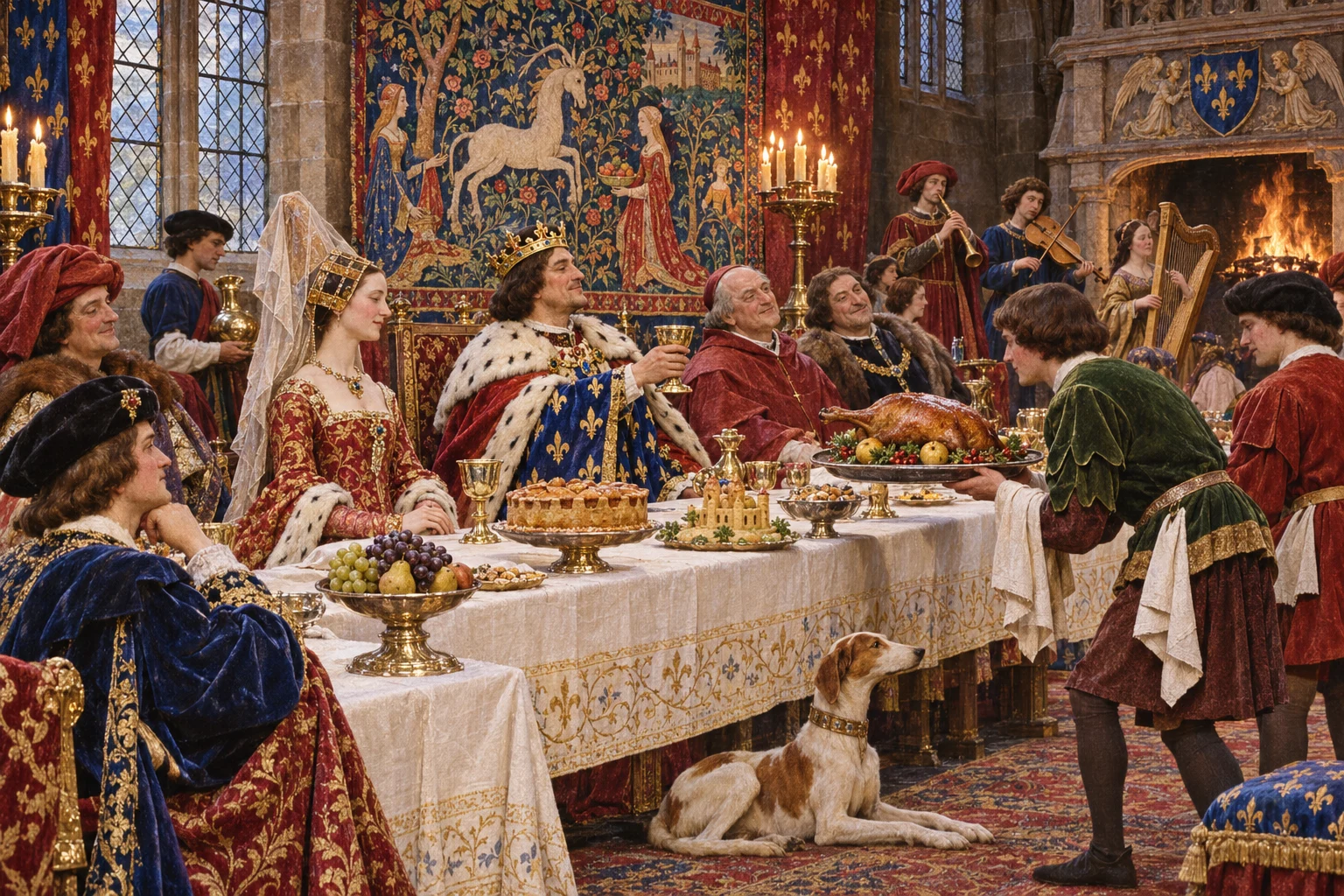
Imagine a banquet setting where attendees are dressed up in their finest silk, furs, and jewels. The venue is palatial, the walls hung with elaborate tapestries. Flames crackle in the massive fireplace. While serenading musicians mingle with the noble retinue, dogs hover expectantly. Diners will remain for many hours, perhaps even for several days, to savor a feast so lavish in scale that even the most extravagant Chaîne dinners of today would pale in comparison.
Such banquets were the sociopolitical centerpieces of aristocratic life in the Middle Ages, and our Chaîne ancestors—the royal goose roasters—would have contributed to them extensively.
Hospitality, wealth and power
During the Middle Ages, food embodied political clout among the wealthy. As culinary historian Bridget Henisch noted, “In the cut-throat realities of everyday life, to nourish was not so much an act of love as a demonstration of power.… Lavish generosity was the hallmark of the important man” (Henisch, 10–11). Nobles, including kings, were sometimes bankrupted by extravagance because evidence of frugality could be met with contempt.
“Lavish generosity was the hallmark of the important man.”
Bridget Henisch, quoted by Judith Kellogg
Henry III’s motto was, “He who does not give what he has, does not receive what he wants.” Ironically, he also exemplified a powerful man falling from grace. When reckless spending caused him to simplify his hosting, he was lambasted in a 1250 chronicle: “The lord king, shamelessly departing from his father’s footsteps, ordered the expenses of his court and the customary pleasures of hospitality to be cut back, even so as to incur the reproach of inexcusable avarice” (Paris, 141).
A feast for every sense
Given this highly charged cultural dynamic around food, the noble medieval meal was an elaborate performance, orchestrated to appeal to all of the senses. Quantities were immense. Since the wealthy could afford spices unavailable to most, rich sauces were expected. Then, as now, French wines held a privileged place at the table. Serving vessels were of gold, silver, or refined earthenware, the most coveted pottery made in Spain.
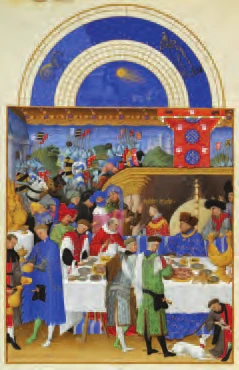
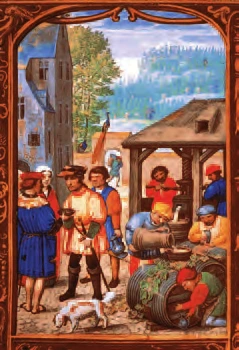
Lavish dishes were presented in succession, and each was appreciated in its own right without regard for the menu’s balance, as in a modern Chaîne dinner. One record enumerates twenty-six courses for one meal. Another document from circa 1400 lists the projected supplies for a two-day meal for five hundred guests as follows: domestic meats, game meats, fish in remarkable quantities and varieties, eggs (12,000), spices (the essentials being ginger, cinnamon, cloves, grains of paradise, long pepper, spikenard, black and white pepper, mace, saffron, galingale, and nutmeg), nuts, fruits, cheeses, flour (3,600 lbs.), colorants (including eighteen lbs. of gold leaf), spiced candies, vinegar (832 gallons), verjuice (1,040 gallons), oil, and wines for cooking (Scully, 41–42).
When food became art
“Spectacle was paramount.”
Judith Kellogg
Food also became art. It was often painted or sculpted; sometimes it was embellished with gold, enamel, jewels, and ivory. Dishes were fashioned to resemble battlements and towers. Sometimes, fare portrayed imagined beasts. For instance, spiced pork belly might be shaped like a hedgehog, with fried almonds representing the bristles. Occasionally, food conveyed a message. At the coronation feast for Henry V in 1413, six roast cygnets were arranged around a roast swan to suggest the homage of the great barons to the newly crowned king.
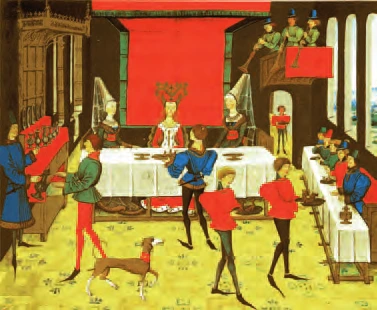
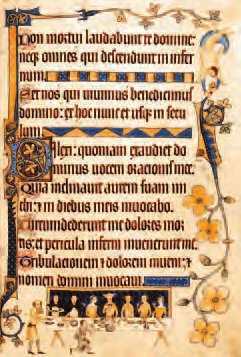
Spectacle was paramount and extended beyond food presentation, with entertainment punctuating the myriad courses. Musicians, acrobats, animal trainers, magicians, comedians, singers, storytellers, and mimes performed at medieval feasts. Sometimes intricate “interludes,” or short plays, were presented.
At the table: the art of courtesy
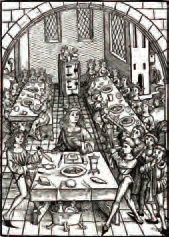
In contrast was the simplicity of the table, where bread, a cup, a knife, and one’s fingers were the essentials. Fine white linen was required. One was expected to bring one’s own knife, the handle as fancy as one could afford. Good white bread served as spoon, plate, and towel. Diners ate with their fingers from common platters and pots, dipping bread into the sauces. One generally shared a cup, so etiquette required that one’s mouth be cleaned of grease or food before drinking. The well bred were taught to wipe their hands and knives on tablecloths only after cleaning them first with bread. Shared washbowls, infused with sage, rosemary, chamomile, or rose petals, were available before and after meals. Bones and other refuse were dropped on the floor, where the canine palace residents served as enthusiastic clean-up crews.
Formal manners were strictly prescribed and studied. Powerful aristocrats established reputations for generous hospitality at banquets, while guests demonstrated their nobility through refined manners. In the early Middle Ages, military prowess determined one’s social rank. As the centuries progressed, traditional chivalric knights became obsolete in practice and ladies took on more prominent social roles. “Courtesy”—the art of proper public “court” behavior—distinguished the elite.
Behind the banquet
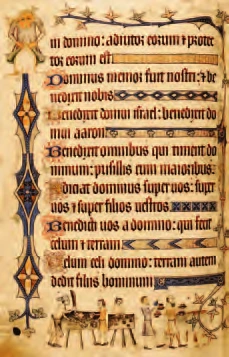
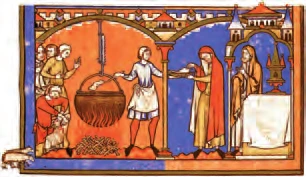
It took countless people and a vast castle infrastructure to prepare a medieval banquet. Although low in social standing, a skillful cook who could coordinate meals was highly valued. Nobles wanted a cook who resembled “a wizard, ready to work his magic on a handful of ingredients and transform them into a dish fit for a king. Any cook who could do this named his own price, rested on his ladle, and waited to be wooed” (Henisch, 71). Although lowly kitchen boys did the actual turning, the “art” included managing the fire, placing the spit, preparing sauces, and overseeing the decoration.
“A wizard, ready to work his magic on a handful of ingredients…”
Bridget Henisch, quoted by Judith Kellogg
07 · A final word
The swan’s lament
But what of the poor goose, who made notable, albeit less enthusiastic, contributions to the medieval table? The sentiments of his cousin, the swan, no doubt echo his own. An anonymous thirteenth-century poet records the swan’s lament, which is best known for its inclusion in Carl Orff’s Carmina Burana (based on the medieval poetry collection of that name).
Aforetime, by the waters wan,
This lovely body I put on:
In life I was a stately swan.Ah me! Ah me!
Now browned and basted thoroughly.
The cook now turns me round and turns me.
The hurrying waiter next concerns me,
But oh, this fire, how fierce it burns me!Ah me! Ah me!
(Whicher, 251)
Works cited
Henisch, Bridget, Fast and Feast: Food in Medieval Society. University Park: University of Pennsylvania Press, 1997.
Paris, Matthew, The Illustrated Chronicles of Matthew Paris: Observations of Thirteenth Century Life, trans. Richard Vaughan. Cambridge, UK: Alan Sutton, 1993.
Scully, D. Eleanor and Terence, Early French Cookery: Sources, History, Original Recipes and Modern Adaptations. Ann Arbor: University of Michigan Press, 1995.
Whicher, George, editor and translator, The Goliard Poets: Medieval Latin Songs and Satires. New York: New Directions, 1965.
Judith’s original text and references have been retained, with section headings and a new visual layout added for this web edition. Historical illustrations are reproduced from the original article.